
Temporomandibular (jaw) joint problems

What are they?

The joint between your upper and lower jaws, just in front of your ears, is called the temporomandibular joint (TMJ for short). A fibrous disc separates the upper and lower bone surfaces. The jaw joints can occasionally cause problems, which your dentist can help diagnose and treat.

What are your symptoms?

  • Clicking and grating noises when you move your jaw.
  • Difficulty opening and closing your mouth.
  • Swelling or tenderness of the joint.
  • Pain in the face, neck and chewing muscles (some people also have pain in shoulders and / or back).
  • Headaches or migraine, especially first thing in the morning.
  • Pain in your ear, possibly with ringing noises.

Clicking or grating noises are usually down to the cartilage jumping when you open your mouth.

The problem can be addressed by:

  • Cutting up food into small pieces.
  • Avoiding very chewy foods.
  • Avoiding very hard foods.
  • Trying not to open your mouth too wide – for example, when you yawn.

Jaw joint pain is usually the result of increased tension in the jaw muscles.

Factors involved in this include:

  • Grinding or clenching your teeth, in your sleep or during the day.
  • Habits such as biting your nails or chewing a pen.

These are often related to fatigue, stress and anxiety.

Painkillers and sedatives can relieve symptoms in the short term.

Possible solutions to the underlying problem include:

  • Using relaxation and stress-relieving techniques.
  • Giving up habits that aggravate the condition.
  • Wearing a ‘biteguard’ at night, to stop you grinding your teeth in your sleep.

Some people may be experiencing jaw problems due to the way their teeth or dentures meet when they bite. This can be resolved by adjusting the position or shape of some teeth, by replacing missing teeth with dentures or implants, or by making a new denture, as necessary.

Speak to your local Clear Dental Practice to learn more.

Healthy Eating

Why does healthy eating matter?

Your general health and your resistance to may diseases depend a lot on eating a healthy, balanced diet.

Your eating and drinking habits also affect the health of your teeth.

Dental plaque is a soft, sticky substance that builds up on your teeth. It is mostly made up of bacteria, which feed on sugar from food and drink, producing acids as a waste product. The acids attack the teeth by dissolving the minerals in the tooth surface. If this happens too often, tooth decay results.

Acids in food and drink can dissolve away tooth surface. All fizzy drinks (including ‘diet’ brands and fizzy mineral water), all squashes and all fruit juices are acidic to varying degrees. Pickles and citrus fruits are examples of acidic types of food.

After an acid attack, teeth can repair themselves, given the opportunity. It helps if fluoride (a mineral that is an ingredient in most toothpaste) is present in the mouth.

Most dental problems can be avoided if you:

  • Remove plaque by brushing twice a day with fluoride toothpaste.
  • Don’t have sugary and / or acidic food and drink too often during the day. Try to have these mostly at mealtimes, not in between.
  • Chew sugar-free gum, which can also help as this increases the flow of salvia which helps teeth to repair themselves.

Between meals you should only have ‘safe’ drinks, which are not sugary or acidic. Milk and water are ‘safe’ drinks. So are tea and coffee if you don’t add sugar to them (you can use non-sugar sweeteners).  

You should try and avoid snacking between meals. If you do snack, only have ‘safe’ snacks, which are not sugary or acidic. Vegetables, nuts breads/crackers and plain popcorn are all examples of ‘safe’ snacks. Dairy products, such as cheese, are also ‘safe’ snacks for teeth; for the sake of your general health, choose lower fat varieties and don’t have too much.

To stay healthy, you should be eating at least 5 portions of vegetables and fruit a day. Although fruits are healthy foods, they contain natural sugars and acids so try not to eat these too often between meals.

Remember the rules:

  • Always brush your teeth twice a day with fluoride toothpaste.
  • Only have ‘safe’ drinks and ‘safe’ snacks between meals.
  • Eat at least five portions of vegetables and fruit every day.

Speak to your local Clear Dental Practice to learn more.
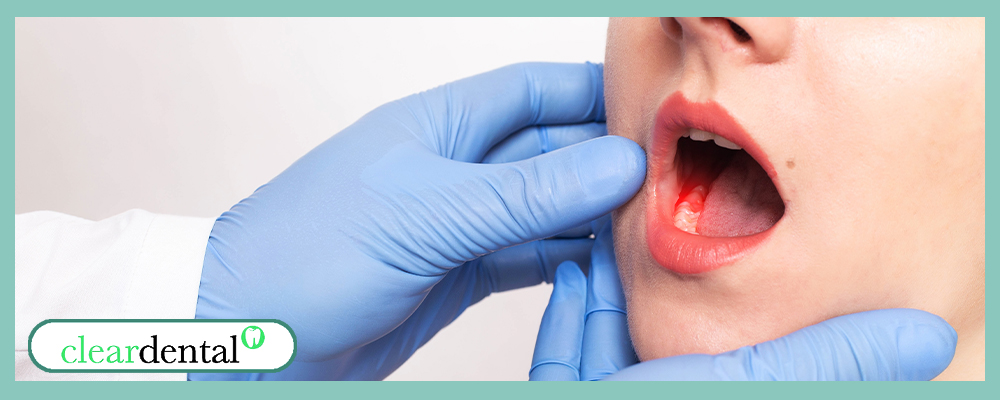
Mouth Cancer

What is it?

Mouth cancer is a dangerous abnormal growth that can affect any part of the mouth.

What are the signs of mouth cancer?

Mouth cancer can appear as:

  • An ulcer that fails to clear up after about three weeks.
  • A growth or swelling which has been present for more than about three weeks.
  • Sometimes, as a white or red patch in the mouth.

Most things like this will not turn out to be cancer, but if you have these signs, they must be investigated by going to your dentist immediately.

Am I at risk from mouth cancer?

  • If you use tobacco (smoked or chewed) or chew Pan/Betel nut, you could be at risk. Drinking alcohol will also increase your risk of mouth cancer. If you do more than one, your chances of getting it are vastly increased.
  • Prolonged exposure to sunlight can increase your risk of lip and skin cancer.
  • The chances of getting mouth cancer are greater for people aged over 40 years, but younger people can get it too.
  • You are more at risk of cancer if you don’t eat a healthy diet.

How can mouth cancer be detected?

You dentist can spot mouth cancer early. Your chances of survival are as high as 90% with early detection, compared to only 50% if it is diagnosed late. Over 7,000 people are now diagnosed with mouth cancer per year in the UK and, unlike for most cancers, the number of cases is increasing.

What will my dentist do?

You should expect your dentist to:

  • Look at your face and neck.
  • Feel under your jaw and down your neck.
  • Examine the inside of your mouth with a small mirror, looking at your lips, cheeks, tongue, the roof of your mouth and your throat. Your dentist can see parts of your mouth that you can’t easily see or feel yourself. Your dentist may notice something in your mouth that needs to be monitored or needs to be seen by a specialist.

What are the benefits of being regularly checked?

Regular examinations mean that your dentist can spot problems early – and these include mouth cancer.

How can I prevent mouth cancer?

By following a healthy diet, with five to seven portions of fruit and vegetables each day, you can help to prevent mouth cancer as well as many other cancers and diseases (a portion is roughly a handful).

Do not use tobacco at all and reduce your alcohol consumption as much as possible, keeping your weekly intake to below 14 units, spread over at least 3 days (one unit is roughly equal to a single measure of a spirit, a half pint of beer or a small glass of wine).

Speak to your local Clear Dental Practice to learn more.

Endodontic (root canal) treatment

What is it?

Teeth are held in the jaws by their roots. Front teeth normally have one root, but teeth further back have more.

At the core of each tooth is a soft mass of tissue called the pulp. In a healthy tooth, the pulp contains living fibres, cells, nerves and a blood supply, extending into the root(s) through the root canal(s).

Decay or injury can destroy the living pulp. Because dead pulps lacks a blood supply, it is more prone to infection, leading to an abscess and toothache.

Root canal treatment (also known as root filling or endodontics) meaning removing damaged or dead pulp and filling the space left.

The remaining tooth can then be repaired.

What will my dentist do?

  • An X-ray can show the number and shape of the root canals, and also signs of infection in the surrounding bone. Teeth can have a number of roots and some roots are easier to fill than others, because of their shape.
  • To keep canals dry during treatment the dentist may stretch a sheet of thin rubber around the tooth, on a frame outside the mouth; this is called ‘rubber dam’. Having this fitted makes the treatment more comfortable.
  • You will be given a local anaesthetic, and then an opening is made through the top of the tooth, down into the pulp.
  • The dentist then uses narrow files to remove the dead pulp from the core of the tooth and from the root canal(s).
  • At this point, the dentist may put in a temporary filling. Occasionally, infection may spread beyond the tooth and you will need to contact your dentist, who will review the situation, especially if you have a raised temperature and feel unwell. The dentist will guide you through this stage, and once symptoms have settled, the treatment will be continued.
  • In the next stage, the dentist fills the root canal(s). A filling is then placed in the remaining cavity at the top of the tooth. Or, if necessary, a crown can be placed on top pf the tooth, supported by a post placed inside the filled root canal.
  • If you have pain during treatment, this can be controlled using analgesics.
  • Root filled teeth can become darker than other teeth, but bleaching can be used to make them look lighter.

What are the benefits?

  • Pulp damage can cause toothache but the pain will usually end very quickly when the root canal is cleaned out.
  • Without a root filling, a toth with a dead pulp would probably have to be taken out in the end. There is also a possibility of infection spreading beyond the tooth itself.
  • Root-fillings are usually successful and can last many years, but re-treatment is also possible if infection recurs. Occasionally, if inflammation persists at the tip of the root, surgery can be carried out to remove part of the root, clean the area and put in a filling. This is known as ‘apicectomy’.
  • A proportion of root canal treatments fail despite the clinician’s best efforts. In these circumstances a discussion with your dentist will indicate options for the future.

Speak to your local Clear Dental Practice to learn more.

Silver fillings

What are they?

A filling replaces part of a tooth that has been lost because of decay or through accidental damage.

Silver fillings are made of dental amalgam – a mixture of mercury with other metals, including silver, tin and copper. Amalgam is soft at first, but quickly becomes hard once placed in the tooth. Dentists use amalgam because it is tough and safe. However, there are alternatives to amalgam such as white fillings.

What will my dentist do?

Your dentist will:

  • usually numb the tooth and surrounding area with an injection – some small fillings may not need an anaesthetic.
  • Remove any decay, together with any old filling material, using a small, high-speed drill.
  • Remove any weak part of the tooth that might break later.
  • Shape the cavity, so that the tooth will hold the filling in place.
  • Possibly cut a cement lining in the bottom of the cavity before inserting the filling.
  • Pack soft amalgam tightly into the cavity – you might hear a squeaking noise as it goes in. The dentist might put a thin metal band around the tooth prior to packing the amalgam to help control the shape of the filling.
  • Carve the filling to fit the tooth.
  • Ask you to close your teeth together gently, to check that the filling is the right height and is comfortable.
  • Make any necessary small adjustments to the filling at the next visit.

What are the benefits?

  • A filling rebuilds the tooth so you can chew.
  • If decay is left unchecked, it can spread deep into the tooth, causing pain and infection. This could mean the tooth has to be root filled or even taken out.
  • A filling can prevent further toothache or discomfort.
  • Silver fillings are very strong and perform well in back teeth, where there is heavy wear from chewing. They do, however, have the cosmetic drawback of not being tooth coloured. Tooth coloured filling materials, which look better, require less drilling and can be repaired, are also available, but take longer to place and may wear less than silver fillings. Silver fillings are best used when existing silver fillings need to be replaced and in situations where the use of a tooth coloured filling material is difficult.

Speak to your local Clear Dental Practice to learn more.

Tooth whitening

What is it?

Like hair and skin, teeth vary in colour. Some are yellower or darker than others, even when they are quite healthy. teeth tend to get darker as people get older.

Teeth sometimes become darker if their roots have been damaged or diseased and the ‘nerve’ has died.

Tooth colour can be very effectively lightened with Hydrogen Peroxide (bleach), used on either the outside or the inside of the tooth.

Tooth bleaching is safe as long as the bleach does not touch your gums and burn them. Dentists use a special jelly bleach.

Tooth whitening should only be carried out by a trained dental professional.

What will my dentist do?

Where the ‘nerve’ of a tooth has ‘died’ (through damage or disease) and the tooth’s root has been filled, bleach is put inside the tooth, under a removable try or temporary dressing. This can take from a few days to a week.

There are two ways of bleaching the outside of teeth. One takes place at home and the other in a dentist’s surgery.

Home bleaching works like this:

  • The dentist will give you weak bleach jelly to use at home in a tray which fits closely round your teeth. The tray makes sure that the jelly does not burn your gums. You will need to put the tray in your mouth overnight (for a few hours) on several occasions, as instructed by your dentist (probably over a period of weeks)
  • The dentist will need to use a putty-like material to make moulds of your mouth (called ‘impressions’), so a dental technician can make the tray to fit. At your next appointment, your dentist will check that the tray fits and show how you put the bleach in the tray at home.

Bleaching in the surgery looks like this:

  • Your dentist (or dental care professional) will use a stronger bleach jelly than is used for home bleaching. Dentists use this method to bleach all the teeth at the same time in either your upper or lower jaw. The strong bleach will touch the teeth for less time than with home bleaching
  • The dentist should protect your gums. They will paint the bleach onto the teeth and either shine a special light at them or just leave the bleach on the teeth for some time
  • The bleach is then washed off with water.

For both techniques, your dentist will make a note of your tooth colour using model teeth in different shades before they treat you. Look at the colour match yourself before the treatment, so you can compare it with the colour after bleaching. Occasionally bleaching can cause your teeth to become more sensitive to hot, cold and sweet things. Should this occur, stop bleaching for a night or two if you are using the nightguard bleach, and use desensitising toothpaste. If the problems persists, see your dentist.

Over-bleaching can also lead to sensitivity or less of vitality (where the tooth dies) which is why it is essential for the procedure to be carried out by a trained dental professional.

What are the benefits?

Bleaching improves the appearance of your teeth without removing any of the natural tooth surface. Bleaching is a better option than a crown or veneer if you want to lighten the colour of healthy teeth, as the placing of crowns and veneers involves changing the shape of the tooth.

Speak to your local Clear Dental Practice to learn more about tooth whitening.