
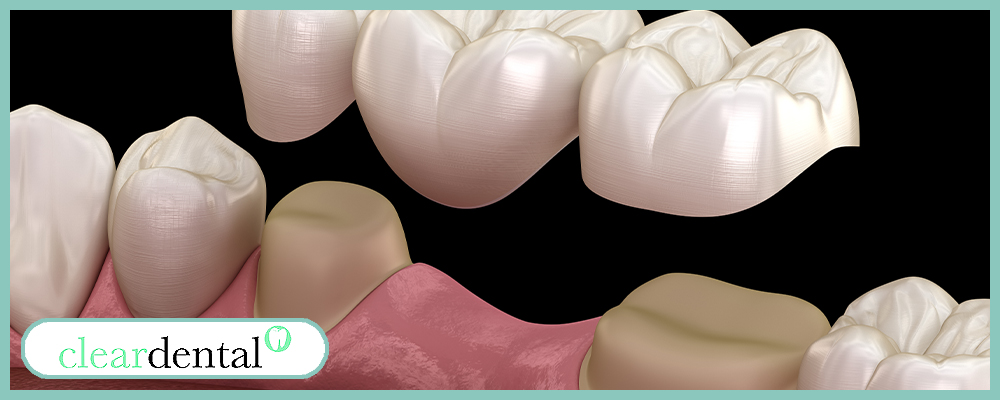
Fixed bridges

What are they?

A bridge fixes a replacement tooth (or teeth) to one or more remaining natural teeth or implants. Some bridges have crowns at each end. Others are fixed to the surface of the teeth next to the gap. Sometimes a bridge is only fixed to the tooth on one side of the gap.

Bridges are made of metal and porcelain or sometimes just porcelain.

What will my dentist do?

There are several stages in making a bridge:

• The dentist uses a soft, mouldable material to take impressions of your mouth. A dental technician makes exact plaster models of your uppper and lower teeth and gums, which show how your teeth bite together.

• The teeth that will support the bridge are prepared to take the fixings and to make sure that the bridge is not too bulky.

• Another impression is taken of the teeth and any gaps, and the dental technician uses this to make the bridge. A plastic temporary bridge or temporary crown may be fitted in the meantime.

• At your final visit, the dentist will check that the bridge fits, make any minor adjustments and then fix it permanently in place. Your dentist or hygienist will show you the best way of keeping your new bridge clean.

What are the benefits?

• A bridge lets you almost forget that you have missing teeth.

• It can improve the way you look, bite, chew and speak.

• The teeth can be matched to the colour of your own teeth.

• A bridge can last many years if you keep it and the adjacent soft tissue clean and if there is no accidental damage.

• Natural teeth are protected from wear and tear, and from moving or tilting out of line, which could cause your teeth to bite together incorrectly.

Other options…

It may be possible to restore small spaces with one or more dental implants. This has the advantage that adjacent teeth do not need to be cut, but the disadvantage that a surgical procedure is required, and treatment time may be extended. Implants are not widely available within the NHS, apart from in certain situations.

Another option for a small space could be a ‘minimum preparation bridge’, where the false tooth is held in place with a wing that is bonded onto adjacent teeth. This involves less destruction of tooth tissue but can require repair or replacement.

Longer, or multiple, spaces may be restored with acrylic or metal partial dentures. These are removable and so are easier to keep clean; it’s also easier to clean the adjacent natural teeth. However, some patients find dentures difficult to tolerate.

Fissure sealants

What are fissure sealants?

Fissures are grooves usually found in the chewing surface of back teeth. They are difficult to keep clean so there is more risk of decay. Fissures can be sealed with tough plastic to protect them.

The plastic is runny at first but sets hard, like paint Sealants may be see-through or tooth-coloured. They are normally only used for children and only on permanent teeth, not on milk teeth.

Your dentist will discuss whether your child needs sealants. If they do, you will also have to agree which teeth need to be sealed. The need for sealants will depend on:

• the shape of each tooth;

• how much a child’s teeth have already decayed;

• how much decay a brother or sister has had (because there can be family patterns in tooth decay); and

• a child’s general health (because general health problems can make it especially important to avoid dental problems).

What will my dentist do?

The dentist will:

• clean the tooth thoroughly with a rotating brush or rubber polisher

• dry the tooth and keep it dry by putting cotton wool round it and using suction

• dab a mild acid on the tooth and leave it for a short time to make the tooth surface rough (this will not hurt at all)

• wash and dry the tooth by blowing water and then air onto it

• change the cotton wool rolls around the tooth to keep it dry

• paint the plastic onto the fissures

• harden the plastic by pointing a bright light at it (you will see the dentist and dental nurse protecting their eyes)

• check that the tooth is comfortable to bite on

• trim the sealant

What are the benefits?

• Fissures sealants protect teeth from decay.

• They can last for years. Or, if they fall out or wear out, they can usually be replaced if there is no decay underneath.

Dental implants

What are they?

Implants are one way of replacing missing teeth.

Unlike other forms of replacement teeth, dental implants are small metal (mostly titanium) devices not unlike a screw fitting which are inserted into the jaw during surgery. Teeth, in the form of a crown or bridge are often then attached to the implant, or the implant can be used to support dentures.

What are the benefits?

Some people have real difficulties with removable dentures. Implants can overcome these difficulties, in particular for eating and speaking properly and they may improve appearance. If a denture is necessary, implants can greatly improve stability. People will not be able to see that your teeth are supported by implants. Implants can be used in place of bridges, for example when adjacent teeth are intact or may not be strong enough to support a bridge.

Are implants for me?

Your dentist should discuss with you whether implants would be right for you, and explain any associated risks.

Patients need to have healthy gums, and enough jawbone to take the implant that supports the replacement teeth although techniques are available to add (graft) additional bone if needed. Patients must also be prepared to maintain very good oral hygiene and visit the dentist regularly. Implants, like teeth, may be lost if mouth hygiene is poor.

Implant patients need to be in good general health. Some chronic diseases, such as diabetes, osteoporosis, or chronic sinus problems, could interfere with healing and make implants more likely to fail.

Make sure that you tell your dentist about any medicines that you take regularly, and about your smoking habits. Smoking may well shorten the life of your implant.

Implants involve treatment over a period of several months. Since they are a complicated form of treatment, implants can be expensive.

What will my dentist do?

Your dentist should tell you about the stages of treatment, who would be carrying out each stage and the timetable for completing treatment. You might be referred to a specialist.

This is what will happen:

  • Bone is exposed in the jaw where the tooth is missing. Then a hole is drilled and the implant is inserted into the bone. This is usually done under a local anaesthetic, but sometimes sedation or a general anaesthetic is necessary. The gum is then stitched over the implant and it’s left to heal for several weeks. This allows bone to grow around the implant and to make it secure.
  • A second procedure is then planned, in which replacement teeth are mounted into the implant. This requires a small cut in the gum above the implant. Once the soft tissues have healed, the replacement teeth may be fixed permanently or attached in a way that lets you remove them for cleaning. The replacement teeth may be single or in a group, and possibly as a ‘bridge’, attached to neighbouring natural teeth.
  • There may be circumstances in which an implant can be placed during the same visit when the tooth is removed.
  • More and more implants are being ‘loaded’ after placement rather than covered by the gum to heal. Please discuss this with your dentist.
  • Maintaining good oral hygiene is important to prevent dental decay and gum disease, which may affect crowned teeth.

Speak to your local Clear Dental Practice to learn more.

Root planning / curettage

What is gum disease?

Gum disease is a complex condition affecting the gums and bone supporting your teeth. Several factors contribute to it, including family history, smoking and chronic diseases such as diabetes.

It begins with plaque, a soft, sticky substance, that builds up on your teeth. Plaque is mostly made up of bacteria, which feed on sugar from food and drink. Tartar, formed by hardened plaque, helps plaque to gather and makes it harder to remove.

If plaque is allowed to build up, the bacteria in it can make your gums sore and infected; they will look red and puffy and hey will probably bleed when you brush your teeth.

The gum will then start to become detached from the tooth, forming ‘pockets’ in which plaque can gather – and bone supporting the tooth will slowly be lost. Because this process is usually painless, it can become very bad without you noticing.

If left unchecked, gum disease will lead to the loss of teeth.

What is root planing / curettage?

Root planing is a way of helping to halt gum disease. It involves ‘deep’ scaling, to clean parts of teeth below the gumline, which cannot be reached with a toothbrush. Root planing cleans out the pockets, and removes plaque and tartar from the tooth roots.

What does the dentist or dental hygienist do?

Dentist and hygienist use two types of instrument for root planing:

  • Hand scalers come in different sizes and shapes to reach different parts of the teeth. This is why you will see the dentist or hygienist changing instruments quite often.
  • Electric scalers use a tip that vibrates very fast in a stream of water. The water is removed from your mouth using a small suction device. A hand scaler is also used along with an electric scaler, to check whether the roots are completely clean.

After a tooth has been root planed, the pocket should shrink, making the gum sit closer to the tooth. You then need to be especially careful about cleaning the teeth above the gumline. Root planing will probably need to be repeated regularly.

Root planing usually takes longer than a normal scale and polish, and is often done under a local anaesthetic. Your mouth might be treated in sections, at more than one visit.

Points to remember:

  • Root planing can help stop gum disease becoming worse and prevent tooth loss
  • Like scaling and polishing, root planing helps you to keep your teeth and gums clean at home.
  • To reduce the risk of your gum disease progressing, do not smoke, and eat a healthy, balanced diet.
  • Dentists and dental hygienists cannot keep your moth healthy by themselves. Your own cleaning is the key.

Speak to your local Clear Dental Practice to learn more.

Keeping a denture or bridge clean

Why is cleaning important?

Just like natural teeth, dentures and bridges collect bits of food, plaque (a sticky deposit, mostly made up of bacteria) and tartar (hardened plaque). By keeping them clean, you can stop decay in any remaining natural teeth and help prevent gum disease (which can lead to tooth-loss). It’s also good for your comfort and appearance to clean dentures, as dirty dentures can make your mouth swollen and sore.

Cleaning a denture is quite easy because, of course, you can take it out of your mouth. Cleaning all round and underneath a fixed bridge is harder. Your dentist or hygienist will show you how to do it.

How do I look after a denture?

  • Clean the denture over a basin of water so that it doesn’t break if you drop it.
  • Brush the denture inside and out every day. Use a soft-to-medium brush so that you do not scratch the denture. Use your normal toothpaste, or soap and water. Then rinse the denture.
  • Ask your dentist about denture-soaking solutions. Soaking a denture will not clean it. You also need to brush it. Rinse the denture before you put it back in your mouth.
  • Ideally, denture should be left out of the mouth for at least four to six hours, preferably eight hours, in every 24. However, if you find this impractical or embarrassing, you should still make sure you clean your dentures by brushing with toothbrush and toothpaste.
  • Keep a denture dry or in a denture-soaking solution when you are not wearing it. These solutions are mild disinfectants available at all chemists’ shops.

How do I clean a bridge?

  • How you clean will depend on where the bridge is in the mouth and its design. As well as normal brushing with a fluoride toothpaste and flossing at each end of the bridge, you need to keep the bridge clean underneath.

You might use:

  • Floss with a threader or a special floss with a stiff end which you can poke underneath the bridge and pull through
  • ‘Bottle brushes’ (your dentist will tell you what size and shape to buy) or
  • Water jets – sending a stream of water under the bridge

What are the benefits?

  • By keeping a denture or bridge clean, you help keep your gums and teeth healthy and avoid bad breath.
  • People who wear dentures sometimes get an infection called oral thrush. Thrush is more likely if you wear the denture all the time.

Good denture hygiene is important for preventing oral thrush.

Speak to your local Clear Dental Practice to learn more.

Tooth erosion

What is it?

Acids in the mouth can dissolve away tooth surfaces. Given the chance, teeth with repair themselves, using minerals from saliva. But if acid is in the mouth too often, teeth cannot repair themselves and the hard tooth surface (the enamel) becomes thinner – this is called ‘erosion’.

The teeth can then become extra sensitive to hot and cold food and drink. Eroded teeth can also be likely to suffer decay. The appearance of eroded teeth can also change: they can become discoloured (translucent or yellowish), and their shape can be altered.

The main cause of erosion is too frequent consumption of certain kinds of food and drink. All fizzy drinks (including ‘diet’ brands and fizzy mineral water), all ‘sports’ drinks, all squashes and all fruit juices are acidic to varying degrees. Pickles and citrus fruits are examples of acidic types of food.

Some medicines are acidic and, therefore, erosive.

And people with some illnesses (such as eating disorders) may suffer from erosion because of frequent vomiting, as stomach acids also erode teeth. For this reason, dentists may ask about eating disorders if they see teeth are very badly eroded.

How do I prevent erosion?

Don’t have acidic and/or drink too often during the day. Try to have them only at meal-times and drink acidic drinks quickly – don’t sip them. And don’t swash them around your mouth.

Between meals you should only have ‘safe’ drinks, which are not sugary or acidic. Milk and water are ‘safe’ drinks. So are tea and coffee if you do not add sugar to them (you can use non-sugar sweeteners).

You should try and avoid snacking between meals. If you do snack, only have ‘safe’ snacks, which are not sugary or acidic.  Fruits, vegetables and products such as sandwiches, toast, crumpets and pitta bread are all ‘safe’ snacks. You should try and avoid snacking between meals. Some fruits, especially citrus fruits, are acidic and are known to cause erosion if they are consumed in large quantities. This is not normally a problem for most people; however, you could discuss with your dentist or hygienist the safest way to enjoy these fruits.

Because acids temporarily soften the tooth surface, don’t brush your teeth immediately after eating or drinking something acidic. This will allow time for your salvia to neutralise the acid.

How can my dentist help?

Your dentist can identify erosion, pinpoint the causes and advise how to avoid further damage.

Speak to your local Clear Dental Practice to learn more.