Supportive periodontal care (scale and polish)

What is scaling?

Scaling is the removal of hard deposits from the surfaces of the teeth. Scaling is carried out by a dentist, dental therapist or hygienist.

Plaque is a soft, sticky substance that builds up on your teeth. It is mostly made up of bacteria.

The bacteria in plaque feed on sugar from food and drink, producing acids as a waste product. The acids attack the teeth by dissolving the minerals in the tooth surface. If this happens too often, tooth decay results.

And, if plaque is allowed to build up, the bacteria in it can cause gum disease, making your gums sore and infected.

Tartar (also known as ‘calculus’), formed by hardened plaque, helps plaque to gather and makes it harder to remove when you brush. You can’t remove tartar just by brushing your teeth, but a dentist, dental therapist or hygienist can remove it using special instruments – this is known as scaling.

What is polishing?

A dentist, dental therapist or hygienist can also polish your teeth. This removes stains from coffee, tea, cigarettes or red wine; and it makes it more difficult for plaque to stick to your teeth.

If you clean your teeth very thoroughly at home, your scale and polish treatment will take less time.

What happens?

Dentists, dental therapists and hygienists use two types of precision instrument for scaling:

• Hand precision instruments are made of metal and come in different sizes and shapes, to reach different parts of the teeth. This is why you will see the dentist, dental therapist or hygienist changing instruments quite often.

• Sonic/ultrasonic precision instruments use a tip that vibrates very fast in a stream of water. The water is removed from your mouth using a small suction device. A hand precision instrument is also used along with a sonic/ultrasonic instrument, to check whether the teeth are completely clean.

For polishing, your dentist, dental therapist or hygienist will use a rotating brush or rubber polisher with a special toothpaste.

If you have periodontal disease, it may be necessary to carry out deep scaling (periodontal treatment) to clean root surfaces below the level of the gum. You may need a local anaesthetic prior to periodontal treatment.

Your dentist, dental therapist or hygienist will also tell you about the best way to clean your teeth and gums thoroughly at home.

Etch-retained restorations

What are they?

Many of the newer dental materials are adhesive, which means that they stick or ‘bond’ to teeth. The surface of the tooth needs to be made slightly rough so that the repair (the ‘restoration’) can grip properly. This is called ‘etching’ and your dentist will use a harmless mild acid. ‘Etch-retained restorations’ are any repairs attached to the tooth in this way – either fillings, veneers, inlays or onlays.

What will my dentist do?

Your dentist will:

• sometimes numb the tooth, but this is not always needed

• dab the etching acid onto the tooth surface that needs to be roughened

• leave the acid on the tooth for a short time while you keep your mouth open

• wash the tooth very thoroughly with a jet of water, which is sucked out of your mouth through a tube held by the dental nurse

• dry the tooth and check the surface (it might need to be etched again, in the same way)

• paint the ‘bonding agent’ (a sort of glue) onto the roughened area, before filling the tooth or applying some other sort of restoration.

What are the benefits?

• The bond between the tooth and the restoration can be very strong so that the restoration stays in place for a long time. .Even if the bond breaks, it may be possible to re-glue the restoration in place.

• Because restorations are held in place by the bonding agent and not just by the shape of the tooth, less of the natural tooth is lost.

Veneers

What are they?

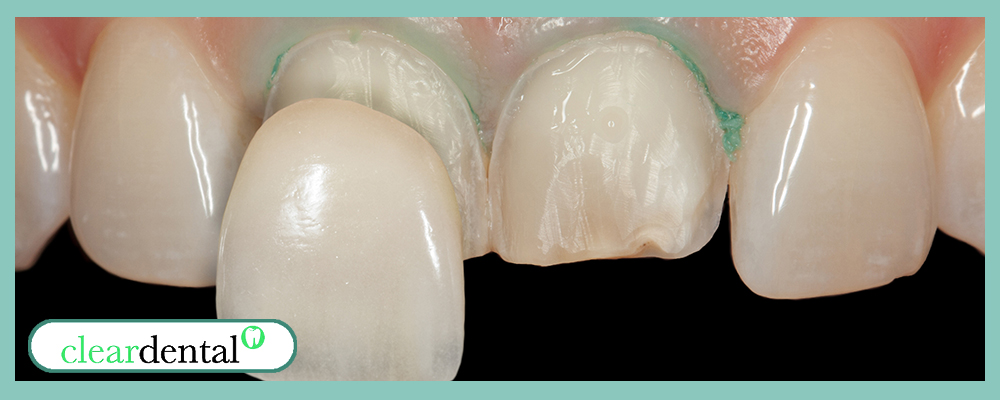
A veneer is a thin layer of tooth-coloured material that is put onto the front of the tooth to make it look better. This is done because the tooth might have been damaged by decay or an accident, or might be badly discoloured for some reason.

What will my dentist do?

Veneers are usually made out of porcelain by a dental technician. You will have to visit the dentist more than once for this type of veneer.

• Your dentist will check any fillings in the teeth first.

• A very small amount of natural tooth material needs to be removed – just enough to prevent the veneer making the tooth look or feel bulky. For this reason, it may not be necessary for the dentist to numb the tooth.

• Preparation time will depend on how damaged the tooth is and whether it needs to be built up with a filling first.

• The dentist will need to use a putty0like material to make a mould of your moth (called an ‘impression’), so the dental technician can tell the shape and size of veneer to make for you.

• Your dentist will glue the veneer made by the technician to the tooth when you next visit.

• Veneers sometimes come away from the tooth or break if the tooth is knocked or if you clench or grind your teeth. They can sometimes be glued back on, but will have to be replaced if they are damaged.

• Occasionally, sensitivity or death of the nerve can occur.

Some veneers are built up on the tooth directly using the same material that is used for white fillings. The surface of the tooth is roughened with a mild acid. Then white filling material is applied in layers until the teeth look right.

Your dentist may recommend trying internal bleaching of the tooth prior to veneer placement. Sometimes this can lighten the tooth sufficiently so that a veneer is not required, or if the tooth is very dark, it can lighten the shade making it easier for the veneer to mask the discolouration.

What are the benefits?

• Veneers can greatly improve your appearance. They hide imperfections, and you lose very little natural tooth material.

• Veneers also protect teeth from any more damage. Tooth surface can be dissolved away by acid in the mouth (usually from too frequent consumption of certain kinds of food and drink); this can make teeth very sensitive to hot and cold. In this situation, veneers can protect the teeth.

If the tooth is strong, a veneer is often a better option than a crown for improving a tooth’s appearance.

Tooth coloured fillings

What are they?

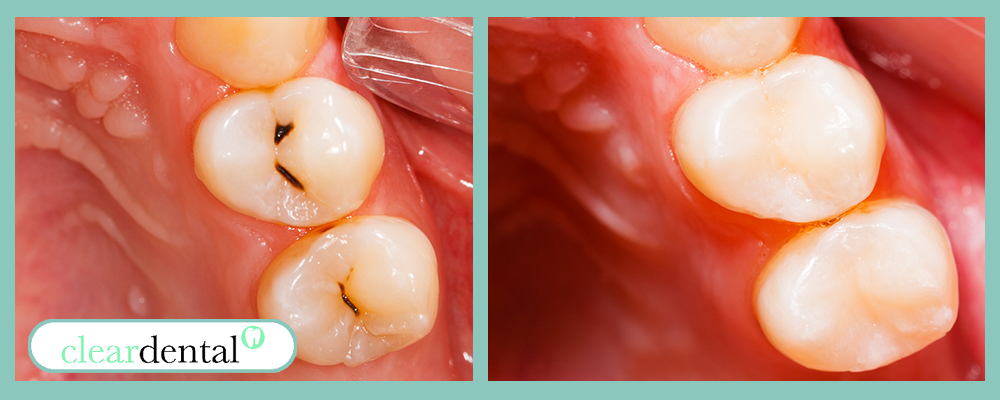
A filling replaces part of a tooth that has been lost because of decay or through accidental damage.

You may hear the dentist talk about ‘composite’, ‘glass ionomer’ and ‘compomer’ – these are different types of tooth coloured filling material.

What will my dentist do?

Your dentist will:

• Usually numb the tooth and adjacent area with an injection – some small fillings may not need this.

• Remove any decay, together with any old filling material, and shape the cavity using a small, high-speed drill.

• Wash and dry the tooth by blowing water and then air onto it.

• Use one of a variety of means to isolate the tooth and keep it dry.

• Apply a special adhesive to the tooth, typically in two or three stages, and then place the filling, again in stages.

• Harden the filling material between stages of the filling procedure, by the use of a bright light shone inside the mouth – this is called ‘curing’.

• Trim the filling as necessary and then polish it, checking that you can bite together comfortably.

What are the benefits?

• A tooth needs less drilling for a tooth coloured filling than for a silver filling.

• Unlike silver fillings, tooth coloured filling materials, which come in different shades to match different coloured teeth, are glued into place, sealing the filling and helping to strengthen the remaining part of the tooth. Tooth coloured filling materials can be used in most situations, including the filling of back teeth and making front teeth look better.

• When used in back teeth, tooth coloured fillings look better than silver fillings, but take longer to place, partly because they are finished and polished in one visit. Tooth coloured fillings may not wear as well as silver fillings but they do have the advantage that they can be repaired, rather than replaced, as and when something goes wrong.

• The longevity of tooth coloured fillings is greatly extended by good oral hygiene.

Fixed bridges

What are they?

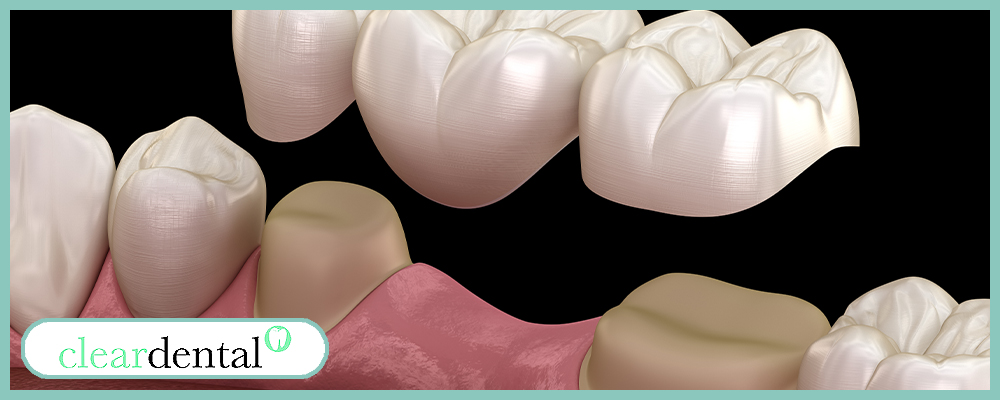
A bridge fixes a replacement tooth (or teeth) to one or more remaining natural teeth or implants. Some bridges have crowns at each end. Others are fixed to the surface of the teeth next to the gap. Sometimes a bridge is only fixed to the tooth on one side of the gap.

Bridges are made of metal and porcelain or sometimes just porcelain.

What will my dentist do?

There are several stages in making a bridge:

• The dentist uses a soft, mouldable material to take impressions of your mouth. A dental technician makes exact plaster models of your uppper and lower teeth and gums, which show how your teeth bite together.

• The teeth that will support the bridge are prepared to take the fixings and to make sure that the bridge is not too bulky.

• Another impression is taken of the teeth and any gaps, and the dental technician uses this to make the bridge. A plastic temporary bridge or temporary crown may be fitted in the meantime.

• At your final visit, the dentist will check that the bridge fits, make any minor adjustments and then fix it permanently in place. Your dentist or hygienist will show you the best way of keeping your new bridge clean.

What are the benefits?

• A bridge lets you almost forget that you have missing teeth.

• It can improve the way you look, bite, chew and speak.

• The teeth can be matched to the colour of your own teeth.

• A bridge can last many years if you keep it and the adjacent soft tissue clean and if there is no accidental damage.

• Natural teeth are protected from wear and tear, and from moving or tilting out of line, which could cause your teeth to bite together incorrectly.

Other options…

It may be possible to restore small spaces with one or more dental implants. This has the advantage that adjacent teeth do not need to be cut, but the disadvantage that a surgical procedure is required, and treatment time may be extended. Implants are not widely available within the NHS, apart from in certain situations.

Another option for a small space could be a ‘minimum preparation bridge’, where the false tooth is held in place with a wing that is bonded onto adjacent teeth. This involves less destruction of tooth tissue but can require repair or replacement.

Longer, or multiple, spaces may be restored with acrylic or metal partial dentures. These are removable and so are easier to keep clean; it’s also easier to clean the adjacent natural teeth. However, some patients find dentures difficult to tolerate.

Dental implants

What are they?

Implants are one way of replacing missing teeth.

Unlike other forms of replacement teeth, dental implants are small metal (mostly titanium) devices not unlike a screw fitting which are inserted into the jaw during surgery. Teeth, in the form of a crown or bridge are often then attached to the implant, or the implant can be used to support dentures.

What are the benefits?

Some people have real difficulties with removable dentures. Implants can overcome these difficulties, in particular for eating and speaking properly and they may improve appearance. If a denture is necessary, implants can greatly improve stability. People will not be able to see that your teeth are supported by implants. Implants can be used in place of bridges, for example when adjacent teeth are intact or may not be strong enough to support a bridge.

Are implants for me?

Your dentist should discuss with you whether implants would be right for you, and explain any associated risks.

Patients need to have healthy gums, and enough jawbone to take the implant that supports the replacement teeth although techniques are available to add (graft) additional bone if needed. Patients must also be prepared to maintain very good oral hygiene and visit the dentist regularly. Implants, like teeth, may be lost if mouth hygiene is poor.

Implant patients need to be in good general health. Some chronic diseases, such as diabetes, osteoporosis, or chronic sinus problems, could interfere with healing and make implants more likely to fail.

Make sure that you tell your dentist about any medicines that you take regularly, and about your smoking habits. Smoking may well shorten the life of your implant.

Implants involve treatment over a period of several months. Since they are a complicated form of treatment, implants can be expensive.

What will my dentist do?

Your dentist should tell you about the stages of treatment, who would be carrying out each stage and the timetable for completing treatment. You might be referred to a specialist.

This is what will happen:

  • Bone is exposed in the jaw where the tooth is missing. Then a hole is drilled and the implant is inserted into the bone. This is usually done under a local anaesthetic, but sometimes sedation or a general anaesthetic is necessary. The gum is then stitched over the implant and it’s left to heal for several weeks. This allows bone to grow around the implant and to make it secure.
  • A second procedure is then planned, in which replacement teeth are mounted into the implant. This requires a small cut in the gum above the implant. Once the soft tissues have healed, the replacement teeth may be fixed permanently or attached in a way that lets you remove them for cleaning. The replacement teeth may be single or in a group, and possibly as a ‘bridge’, attached to neighbouring natural teeth.
  • There may be circumstances in which an implant can be placed during the same visit when the tooth is removed.
  • More and more implants are being ‘loaded’ after placement rather than covered by the gum to heal. Please discuss this with your dentist.
  • Maintaining good oral hygiene is important to prevent dental decay and gum disease, which may affect crowned teeth.

Speak to your local Clear Dental Practice to learn more.